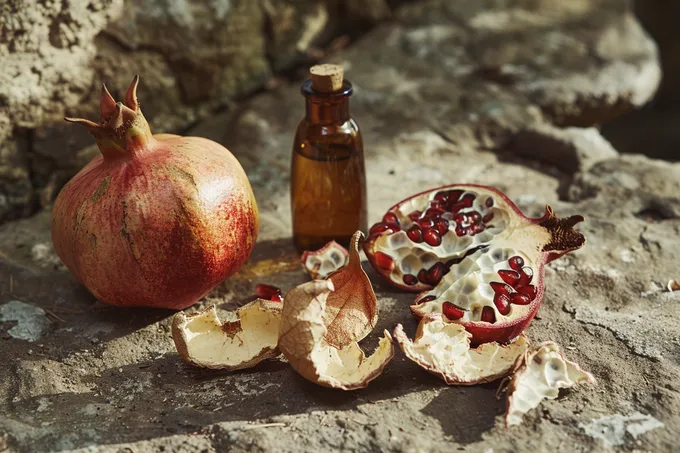
Pomegranate Peel: From the Compost Bin to the Lab
The best part of a pomegranate is the juicy, sweet-tart arils. But the peel left over after eating usually goes straight into the compost bin. The reality of the pomegranate processing industry is even more striking: every ton of fresh fruit processed generates roughly half a ton of peel waste, and globally, more than 1.6 million tons of pomegranate peel are discarded as waste every year, not just a waste of resources, but an environmental burden to dispose of.
What’s interesting is that this discarded peel actually contains a higher concentration of polyphenols than the fruit flesh itself. The most abundant of these is called punicalagin, a natural polyphenol in the ellagitannin family that accounts for more than 85% of the ellagitannins in pomegranate peel. It’s highly water-soluble, but its molecular structure is large and highly polar, which means the stomach and small intestine can barely absorb it directly into the bloodstream.
In other words, even though punicalagin is abundant, it’s a mistake to think of it as something your body simply uses the moment you eat it. Its real work doesn’t begin until it reaches the gut.
Punicalagin Only “Comes Alive” Once It Reaches the Gut
Any punicalagin that isn’t absorbed by the small intestine travels onward to the colon. The colon is home to a huge variety of gut bacteria, which carry enzymes that break open the ester bonds in punicalagin’s molecular structure, first releasing free ellagic acid. This is where the metabolic pathway actually begins.
From there, gut bacteria keep working on the ellagic acid through several rounds of dehydroxylation, gradually turning it into different urolithins. First comes Urolithin M5, and as hydroxyl groups are removed step by step, it becomes Urolithin D/M6, then Urolithin C/M7, and finally Urolithin A or Isourolithin A. In some people, gut bacteria can convert it even further into Urolithin B.
This conversion pathway varies from person to person. Everyone’s gut bacteria are different, so the ability to metabolize punicalagin differs too: some people produce almost no urolithins at all, some produce only Urolithin A, and others can produce Urolithin A, Isourolithin A, and Urolithin B all at once. Age plays a role as well, the proportion of people who can produce a fuller range of urolithins tends to increase with age.
Unlike Urolithin A, covered in our previous article, this piece is about a different intermediate on the same metabolic pathway: Urolithin C.
The Kidneys and Gut Share the Job of Clearing Uric Acid
Getting uric acid out of the body relies mainly on two organs dividing the work: the kidneys handle roughly 70%, and the gut handles the remaining 30%. This isn’t as simple as uric acid just flowing out on its own, it depends on a group of urate transporter proteins to carry it where it needs to go.
In the kidneys, two transporter proteins (URAT1 and GLUT9) are responsible for pulling uric acid back out of the urine and into the blood, a process called reabsorption. Two other transporter proteins (ABCG2 and OAT1) are responsible for moving uric acid from the blood into the urine, ready for excretion. If these two sets of transport work fall out of balance, with reabsorption too strong and excretion too weak, uric acid levels in the blood start to climb. The gut has a similar transport mechanism, relying on many of the same transporter proteins.
In a doctoral dissertation study from Northeast Forestry University, the research team used mouse models and human kidney tubular epithelial cells (HK-2) to observe how punicalagin and Urolithin C affected these transporter proteins. The results showed that, in these animal and cell experiments, both punicalagin and Urolithin C suppressed the two reabsorption transporters while increasing the expression of the two excretion transporters. The research team also observed that in mice fed punicalagin, the gut microbiota shifted: bacteria that produce short-chain fatty acids increased, while bacteria associated with inflammation decreased.
Three Urolithins, Three Different Performances
Urolithin A, B, and C are the three main end products of punicalagin’s metabolism in the gut. The research team compared all three directly in the same mouse and cell models, and Urolithin C consistently outperformed Urolithin A and B on both measures: lowering serum uric acid levels and suppressing the reabsorption transporters.
As for why Urolithin C stood out, the research team offered a hypothesis in their discussion: Urolithin C’s molecular structure has one more hydroxyl group than A or B, and this difference may strengthen its binding to the transporter proteins. But this is only a hypothesis based on structural features, and it hasn’t been confirmed.
All of the findings above come from mouse models and cultured human cells in a lab setting, not human clinical trials, and they don’t necessarily indicate the same effects in people. Elevated blood uric acid or a gout diagnosis both require evaluation and management by a physician. This article cannot substitute for medical advice, so if you’re concerned about your own uric acid levels, please consult a doctor.